
The Central American locust (CAL), Schistocerca piceifrons Walker, is a significant transboundary pest that poses a substantial threat to U.S. agriculture. Its swarms have been observed just south of the U.S.-Mexico border, with computer modeling suggesting that southern Texas will become increasingly favorable for its establishment.
We are seeking your help monitoring for the potential arrival in the U.S. of the Central American locust. However, detecting and identifying CAL in the U.S. is complicated because it has a very similar native – but non-swarming – sister species known as the American Bird grasshopper (Schistocerca americana). The two species can hybridize, setting up the possibility of the invasion of the U.S. either directly by the Central American locust or indirectly by its genes though hybridization.
Location data along the US-Mexico border in south Texas will help guide monitoring and collection efforts to obtain samples for whole genome sequencing and diagnostic species identification assays.
Here you can find more information about submitting sighting information as well as the overall project’s justification and goals.
Submitting location information:
- iNaturalist – South Texas Locust Watch – We have created a companion site using iNaturalist to aggregate sightings of the Central American locust and American Bird grasshopper along the US-Mexico border in Texas.
- Email: TexasLocust@gmail.com – You can also email us directly with your sighting information, if preferred. Please be sure to include (i) location, (i) date and (iii) a photo, if possible. GPS coordinates are helpful, but not required.
All provided location data will be used to direct our team members to areas in south Texas where we can physically collect specimens. The collected insects will be used to develop and test several different diagnostic tools to make it easier to identify whether the insects are the invasive Central American locust, the native American Bird grasshopper, or potentially hybrids between the two.
What are ‘diagnostic tools’ and why do we need them for the Central American locust?
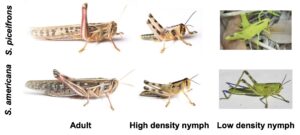
As you can see in the graphic above, adults and juveniles (nymphs) of the Central American locust (S. piceifrons) are nearly identical to its native sister species, the American bird grasshopper (S. americana). Another factor that complicates telling them apart is that both species change how they look and behave depending on whether they grow up in crowds with other individuals – such as during an outbreak – or under more typical low population density conditions. (Photos courtesy of Brandon Woo, BugGuide.net (©Iustin Cret) and Rodriguez-Absi et al., 2009).
Since it is very difficult to distinguish the different species by eye, we are evaluating the use of DNA, Raman spectrometry, and computer vision methods to more readily identify the insects to species. The goal of developing these diagnostic tools is to make it easier to identify the Central American locust when and if it does arrive in the U.S. so that we can more effectively manage it.
This project is part of multifaceted approach to prepare the U.S. for the biosecurity risks associated with the arrival of the Central American locust. Our cooperative team includes personnel and students from Texas A&M University, the University of Texas – Rio Grande Valley, and USDA-APHIS.
